
THE BIG PICTURE: Jonas "Sixkay" Wakewood
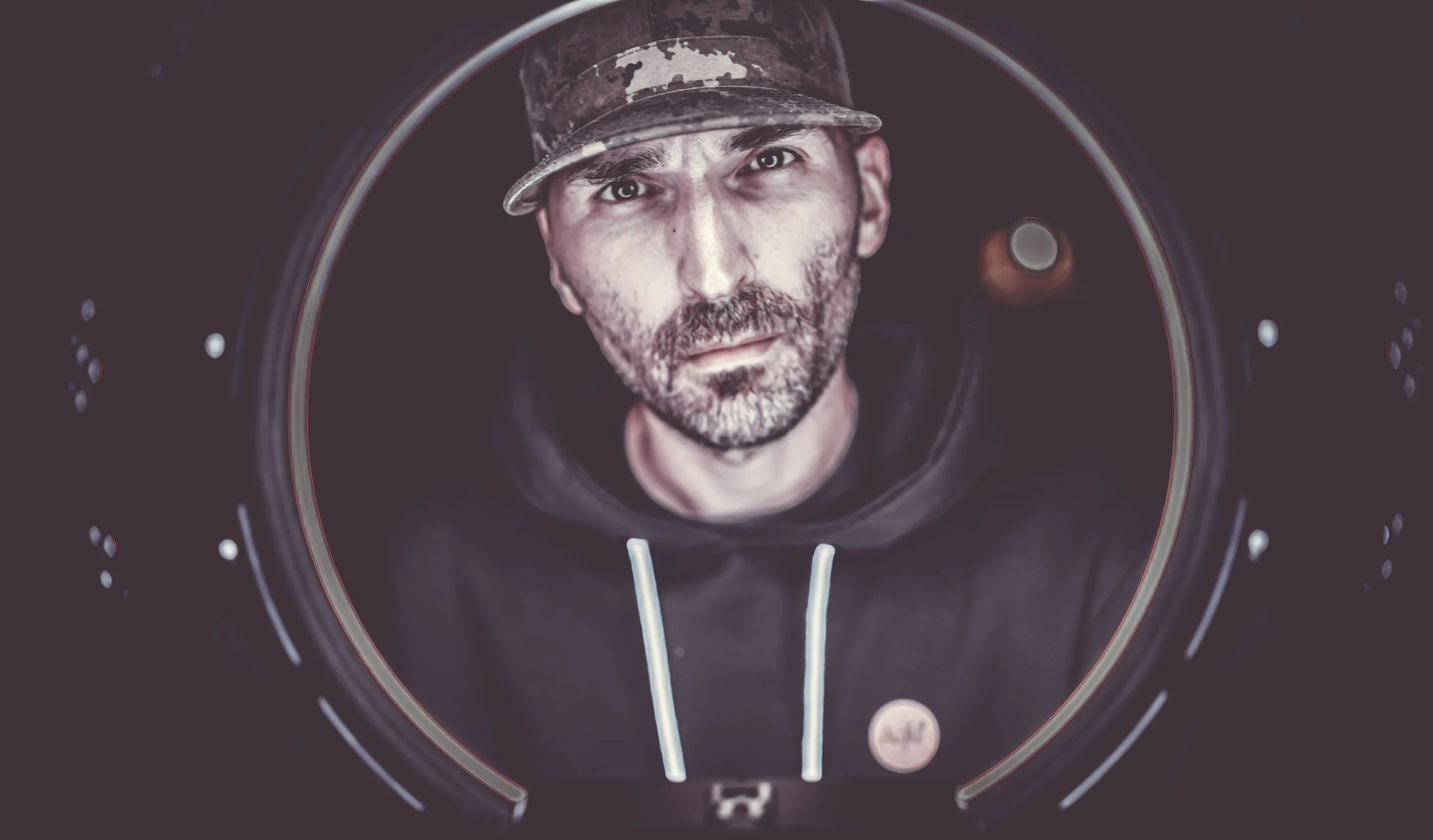
INTERVIEW TERRELL “REALIFE” BLACK PHOTOGRAPH ROGER SWELT
For some, hip-hop is a moment in time. For others, it becomes a lifelong framework—shaping how they create, how they connect, and how they move through the world. Jonas Wakewood, known throughout the underground as Sixkay, belongs to the latter. His journey isn’t defined by trends, algorithms, or industry shortcuts, but by decades of lived experience within the culture. DJing, producing, scratching, filming, photographing, and documenting are not separate pursuits for him; they are interconnected expressions of the same philosophy—respect the craft, honor the people, and stay true to the work.
Growing up in Germany during the early ’90s, Sixkay was introduced to hip-hop through skateboard VHS tapes, record shops, and rare glimpses of American culture that felt raw and unfiltered. It was a time when discovering hip-hop required intention and curiosity, not just access. The music, the attitude, and the energy resonated deeply with him, especially as someone who often felt misunderstood in traditional spaces. Hip-hop became a place of belonging—a culture that spoke to individuality, creativity, and self-expression. From that point on, it wasn’t a question of if he would participate, but how.
That answer came through vinyl and turntables. At a young age, Sixkay committed himself to DJing, working school-break jobs just to afford records and equipment. Long before hip-hop nights were standard in clubs, he was sharpening his skills in youth centers and community spaces, learning DJing as an art form rather than a service. This foundation shaped his entire philosophy behind the decks: play with purpose, educate through music, and never compromise your identity for popularity or money. Even today, his sets reflect that same mindset—intimate, intentional, and rooted in love for the culture.
Parallel to his evolution as a DJ, another instinct was quietly developing: the urge to document. Long before smartphones and digital workflows made visuals accessible, Jonas Wakewood was grabbing camcorders whenever he could, filming skate sessions and everyday moments. That early curiosity eventually grew into a serious commitment to photography and video. Under his given name, he channels the same storytelling sensibility found in his music—capturing artists and communities in unguarded, honest moments. His lens favors reality over polish, emotion over staging, and presence over performance.
These worlds converge powerfully through his long-standing affiliation with the SnowGoons movement. More than a collective, SnowGoons represents connection—bridging continents, generations, and styles while remaining fiercely independent. Through this platform, Sixkay has contributed cuts alongside respected veterans while also supporting emerging artists who carry the culture forward. It’s a reflection of his core belief: hip-hop thrives when experience and youth coexist, when opportunity is shared, and when art remains the priority over profit.
In this conversation with Validated, Sixkay opens up about the duality of his identity as both Jonas Wakewood and Sixkay, tracing a life shaped by hip-hop’s values of community, integrity, and creativity. He speaks candidly about DJing in the vinyl era, the storytelling power of scratches, the freedom he finds behind the camera, and the importance of staying grounded in a fast-moving world. What emerges is a portrait of an artist who doesn’t chase legacy, but lives with intention—someone who understands that hip-hop, at its core, is about connection, contribution, and being a good human being above all else.
VALIDATED: For those meeting you for the first time, who is Jonas Wakewood? Who is Sixkay?
SIXKAY: Both are kind of the same person, but Jonas Wakewood is more the side that focuses on video, photography, and artistic work. Sixkay is my hip-hop persona, which centers around DJing and producing. Whenever I do DJ shows or production work, I use the handle Sixkay. When I do photo work, video blogs, and similar projects, I go by the name Jonas Wakewood.
VALIDATED: What’s the story behind the name Sixway?
SIXKAY: You know, I started DJing around the age of 13, which would have been around 1995. I was born in 1982, and at the time I wasn’t aware of any “cool” DJ names. I’m a down-to-earth guy, and I didn’t want anything big, flashy, or cocky, so I waited a long time before naming myself.
When I was 15, I entered a DJ competition with about eight contenders and ended up taking second place. Around that same time, there was the show Renegade with Lorenzo Lamas, and his sidekick was Bobby Sixkiller. A friend of mine said, “Oh, you killed that set—you’re like a Sixkiller.” I thought about it, but “Sixkiller” wasn’t my thing. It felt too harsh for me.
Later, a friend of mine who was into graffiti was working on a tag and came up with “Six” and “K-A-Y.” I thought, That’s kind of cool. I replaced the number 6 with the word “Six,” and that’s how I landed on “Sixkay.” It felt right for the time, it looked good in written form, and it had meaning to me, so I decided that was it.
Once you’re about ten years into it and people in the hip-hop scene know you by that name, you don’t change it again. I was like, okay, I’m sticking with that. And that’s the story behind it.
VALIDATED: What was your introduction to hip-hop culture while growing up in Germany?
SIXKAY: I have to say my entry point was definitely skateboard videos—specifically the VHS tapes that came over from the States. There was a very small skate shop near us, maybe 10 square feet, with three skateboard decks, two kinds of axles, three pairs of wheels, and no clothing at all. They used to play skate videos on VHS, and I’d just sit there listening to the music.
I’ve always said it’s like trying to explain why you love chocolate ice cream. You can say it tastes good, but you can’t really explain the deeper meaning behind it. That’s how hip-hop felt to me—I just loved it. I fell in love with the vibe, the rawness, the roughness of it. Part of that might also be because I was never really a big “group” guy in school. I often felt misunderstood, and in hip-hop, I found something that truly connected with me.
Most of the people I’ve met in my life—those I consider my real friends—are connected to hip-hop in some way. Whether it’s DJing, breaking, graffiti, or even just listening, all of my friendships came through the hip-hop community. And yes, there are idiots in every scene, no doubt about it, but the real people are genuinely cool, and overall, it’s a great community. I fell straight in love with it.
I also have two older brothers, and in 1994—around the time Wu-Tang Clan released Enter the Wu-Tang (36 Chambers)—they played a show in the city where I grew up. My older brother snuck me in, even though I was too young to be there. I was completely blown away. That experience made me think, Okay, this is it. This is incredible.
After that, I started working holiday jobs during school breaks to earn money for turntables. I fell in love with DJing immediately. I wasn’t trying to be another rapper, writer, or breaker. I wasn’t good at dancing—my body just wasn’t built for that. But I was fascinated by vinyl and completely drawn to the art of spinning records.
That’s where it all started—very early on, around 1992 or 1993, when I was 12 or 13 years old. I’ve been into hip-hop ever since, and I never left.
VALIDATED: When did you first realize you had a gift for both sound and visual?
SIXKAY: I think I realized it later, but I had already started doing it. When I began DJing and met people who were also producing music, I was always saying, “Hey, we should film this. We should do that.”
I started skateboarding when I was around 10 or 11 years old, and even back then I would grab a camcorder whenever one was available. At that time, there were no iPhones you could just keep in your pocket. Today, I can film in 120 frames per second, but back then camcorders were very expensive and difficult to use. There was no simple computer process where you could just drop a file onto your computer—you had to play everything in manually. It was a lot of work.
After school, I realized that the normal path—learning a traditional job—wasn’t for me. I went to several job interviews, and during one of them the interviewer asked me, “Why do you want this job?” In that moment, I realized I didn’t want it at all. I couldn’t give him an answer. The only thing I could say was, “I don’t know.”
That was when I understood I had to go my own way. I started asking myself, “What can I do to earn money and pay for living expenses?” I ended up starting an internship at a TV company, where I did some basic editing work on hotel videos that people could book through a hotline. It was very cheap, low-level work, but I learned a lot.
From there, my path led to more professional projects. Today, most of my income comes from editing and shooting videos for sports documentaries and commercial work. In my free time, I use those same skills to work with artists I enjoy—taking photos, shooting videos, and creating content.
In a way, I do what I love 24/7.
VALIDATED: How did your affiliation with the SnowGoons movement come together?
SIXKAY: It all came together through Manu. I first connected with DJ Illegal, one of the founders of SnowGoons, around 1997 or 1998. At the time, I was a DJ in a rap band called Two Bros—two brothers from the same city where Manu grew up. Back then, Manu owned a record shop in Karlsruhe, a mid-sized city in Germany, and I met him through those guys.
Around that time, Manu was already very well known in the German underground hip-hop scene for his mixtapes. I think he had released nearly 40 or 50 straight-up mixtapes by then. He was one of the first to focus exclusively on German rap, which was unusual at the time. Most mixtapes in the ’90s leaned heavily toward U.S. East Coast hip-hop—A Tribe Called Quest, Nas, and similar artists.
Manu started a mixtape series called Kartoffel Hits, which translates to “Potato Hits.” In Germany, immigrants from other countries—especially Turkey—sometimes referred to Germans as “potatoes.” Germans embraced the nickname, calling themselves Kartoffeln, and Manu used the term as a statement of pride in German rap culture.
I ended up doing my first mixtape with him on a small record label. It was released physically and sold in independent hip-hop shops across Germany. From there, we became friends and kept running into each other at shows—whether I was playing or he was.
Eventually, Manu started the SnowGoons movement. In the early years, he was deeply focused on production but not as much on scratching. So his friends—Danetic, X-Rated, and others he worked closely with—handled the cuts on SnowGoons records. A few years into the movement, he had an idea: Why don’t we create a SnowGoons DJ collective so people know who’s behind the cuts? People would see the names, but not necessarily know who we were.
That’s how the collaboration really came together. We weren’t all from the same city—Danetic was in Berlin, Crypt was in Stuttgart, I was living in Munich, and Manu was in Kreuzheim—so we didn’t meet in person very often. Instead, we stayed connected through the internet, mainly through group chats.
Manu would send a message like, “I’ve got a song with so-and-so. Who wants to do the cuts?” We’d jump in and work on it on the fly. Looking back, we’ve really been rolling together since around 1997 or 1998.
VALIDATED: You contributed the cuts on the GoonBap intro — walk us through how that moment happened.
SIXKAY: It was also very much an on-the-fly moment. The way we produce and bring everything together has to be extremely flexible, because most things happen in real time. Manu makes a connection, gets the green light from an artist, and then it’s like, we have to do it now.
I remember the moment he told me, “We’ve got this intro with Premier on it. He’s talking on the intro, and we need some cuts for it.” I was like, “Okay… this is our intro.” It felt surreal—almost like Star Trek. Even if you’ve met all these guys before, being on a record with your cuts is still a huge thing.
Basically, Manu called me and said, “You want to do it?” And I was like, “What kind of question is that?”Of course I wanted to do it. Who would say no to that? Saying no would’ve been ridiculous. So yeah, it was funny in that way—but also an incredible moment.
VALIDATED: What do the SnowGoons represent for hip-hop culture worldwide to you?
SIXKAY: I think it’s funny, because in Germany we were never really seen as “big.” For a long time—though it’s getting better now—people in Germany didn’t even realize that we were German. It took a long time for them to recognize, “Oh, these guys are actually from here.” That realization alone was kind of crazy.
If I had to narrow it down to one thing SnowGoons represents, it would be connection. Manu is the greatest connector in the world. He’s constantly bringing people together—good people—creating real relationships and building bridges.
That’s what SnowGoons stands for: connecting. When you look at what’s happened over the years, both on a smaller scale and a larger one, you can see the impact. Manu always had an eye for talent. He’d say, “We should work with that guy,” even if it was someone relatively unknown at the time—like K-Prez or others. He believed in giving people opportunities and putting them in the spotlight.
SnowGoons is more than just a group—it’s a movement. It’s a living thing. There are so many people involved, connected to it, and representing it all over the world. That’s the beauty of it.
For me, SnowGoons stands for connection and opportunity. That’s really what it’s all about.
VALIDATED. As a hip-hop fan, I appreciate that you work with both veterans like Bronx MC Nine and emerging artists such as Baltimore’s Jay Royale. The culture needs more of that balance.
SIXKAY: There was a time when we weren’t independent. We were networked with a bigger label. The decision to go independent came down to this: we wanted to be independent because we wanted to do what we wanted to do. It’s not about money.
If it’s about money—if you do things only for money—you start doing things differently. For me, I can’t do that. I can’t create solely for money. Don’t get me wrong: if you’re struggling and can’t pay rent, maybe you take on a commercial job. Even then, in my work, I’m not doing commercials for companies like McDonald’s or Nestlé. I have a moral compass, and Nestlé does a lot of things I don’t agree with, so I don’t want their money and I don’t want to work with them.
That’s a big part of why we made this choice. We don’t focus on the money; we focus on what we want to do. None of us is a millionaire. We live in normal apartments and deal with our own issues. We’re not living some glamorous life. This is about the music. It’s about the art.
Of course, it’s good if you make some money—but that’s not the main focus. The main focus is always the art.
VALIDATED: What's your philosophy behind building a DJ set?
SIXKAY: When I started DJing, there weren’t clubs where you could really play this kind of music. It wasn’t like, “Here’s hip-hop Friday” or anything like that. It was more youth events and community spaces in the city, and that’s where you played. So I basically grew up DJing without seeing it as a job.
Today, DJing can very much be a job. You can get into DJing to serve the crowd—your job is to go into the club, make people dance, make people drink, and if that works, you’ve done your job well. That’s not how I grew up with it. Even to this day, when I DJ, I do it on my own terms. My rule is simple: I have to be happy with it. I don’t play music I don’t want to play, even if it’s a “hot” song. If I don’t feel it, it’s not in my playlist.
Maybe this sounds a bit cocky, but I want to educate people and bring them into my world of music. I’ve always said I don’t want to play because I need the money—I want to play because it’s my art. When I get an email from a club saying, “We want to book you for a show,” I look at the venue. If it’s a big, mainstream club, I’ll say, “Sorry, I can’t do it,” because it won’t fit. I won’t be happy doing it, and the crowd won’t be happy either.
I prefer smaller clubs—200 or 300 people at most, not the big rooms. I want hip-hop heads in the building. That’s the main thing. When I play, I play for the people, but more importantly, with the people. I want us all to have a great time together. I’m not going to change who I am just to be a crowd-pleaser.
I play what I play because that’s my audience. That’s the art.
VALIDATED: Do you approach scratches and cuts as storytelling rather than just a technique?
SIXKAY: For sure—for sure. There are moments where a technique is used purely to flex, whether it’s with the “R,” a flare, or something fresh, where you just go crazy with it. But when it comes to the production of music and songs, I definitely use scratching as a storytelling tool.
I make music with a guy named Roger. He’s from the German band Blumentopf. They’re very, very big in Germany—legends, really. They laid their mics down about ten years ago; I think their last concert was around 2015. The group stepped away, but he’s still making music. In our work together, there are a lot of back-and-forth moments. He’ll rap a part, and then we’ll look for the right acapella to place his sentence in the right way. Then he’ll come back in again—it’s kind of a gimmicky thing. So for me, it’s definitely about storytelling.
Back in 2008 and 2009, I linked up with two other DJs, Snatch Attack and Aspect. We formed a crew called the Deck Packers and started competing in ITF, IDF, and other DJ battles. We put together a six-minute routine for the World Championships. In 2008, we won the German eliminations and then went on to the world stage. There was a lot of work involved in figuring out how to tell a story, because in six minutes you have to show not only your skills, but the entire art form. And the art form is more than just technique. Yes, you have to be technical, but your musicality matters, your ideas matter.
So I’ve always approached it from a storytelling perspective. But for sure, in my opinion, I’m not the best scratcher in the world—no doubt about that. There are so many insanely technical guys out there, and I love watching and hearing that. But with the techniques I can do, I try to use them in the best possible way to get where I want to go. That’s really the thing.
Yeah—I love scratching. I truly love it.
VALIDATED: What's the most memorable set you've ever played and why would you say that?
SIXKAY: I think the most memorable set I ever played was in Manu’s hometown—DJ Illegal’s hometown. It was a Halloween hip-hop event. Not everyone was dressed up or customized or anything; there were just regular people there. The venue was basically a sports hall, like the kind you have in school for gym class, but with a stage set up inside.
I think I was about 20 or 21 at the time. There were six other DJs on the lineup, and I knew all of them. The setup was simple: six DJs, and everyone had about 30 to 45 minutes for their set. Everything was vinyl—no Serato. I worked on my set for about four or five months.
People today don’t always realize what that meant back then. It can sound like one of those “stories from before the war,” but when you only have vinyl and no Serato, and you want to be quick, you have to mark your records. Basically, you cut small stickers and place them exactly on the edge of the record so you know where to drop the needle. You could pick up the needle, drop it, and land right at the part you needed.
My set was very tightly planned. It was like: play this acapella for ten seconds, then switch to this instrumental, then move to the next record. I think I had about 60 records pulled out of my crates and laid out on the table next to me. A friend of mine stood to my left, handing me the records one by one. On the other side, I had a towel laid out so the vinyl wouldn’t get scratched. He’d hand me a record, I’d play it, then put it away, and move straight to the next one.
Those 45 minutes were nonstop. I was constantly moving, playing maybe 60 records, mixing acapellas and remixes the whole time. I’ll remember that set for the rest of my life because it was completely crazy—in the best way. The stacks of vinyl kept growing, everything was taped and prepared, and somehow everything went really well. A live situation is totally different from practicing at home in your living room.
But yeah—that’s one I’ll never forget, for sure.
VALIDATED. What was the crowd's reaction?
SIXKAY: I think they liked it. They were stunned—more watching than dancing at the time. All the guys behind me were going crazy. They couldn’t believe it, because for some reason I was the only “stupid” guy who did it like that.
I honestly thought the other DJs might do something similar to what I did, but I definitely overstretched it. I have to admit that. Still, it worked out—obviously. Yeah, it worked out.
VALIDATED. Which DJs would you say influenced your style, and what—if anything—did you borrow from them?
SIXKAY: Influencing my style, I think I have to start with Melody from the Beat Junkies. He’s just so clean. I love his cleanness, his accuracy. I’m a fan of the entire Beat Junkies crew—I watched all of their team routines. I love Babu, and I love their whole approach—but Melody always stood out to me because of how incredibly clean he is.
The DJ who probably inspired me the most, though, was DJ Noise from Denmark. He did the 1997 DMC World Championship set, going up against Rock Raida from the Executioners—rest in peace. That set was unbelievably slick and had the most incredible work I had seen up to that point.
If you haven’t watched it, you really should. For 1997, the level of skill, cleanness, accuracy, and style was insane. A lot of DJs from that era who were into the DMC World Championships will tell you the same thing if you bring up DJ Noise’s 1997 set. It was an awesome performance—truly legendary.
Then there’s Mix Master Mike. He’s on a whole different level—so wild and unpredictable. The way he manipulated sounds, especially all the live stuff he did with the Beastie Boys, was just crazy.
Of course, DJ Premier is another huge influence, especially with his word cuts and scratched choruses. I think a lot of DJs learned how a scratched rap hook should sound by listening to Primo. Along with him, Babu, especially through his work with Dilated Peoples, and DJ Revolution—who is also a great, great DJ—were major influences.
But if I had to narrow it down, Melody, DJ Premier, and Babu would be my top three—those were the ones whose work really fascinated me the most. And DJ Noise—seriously, you have to watch that set. Check it out.
VALIDATED: You’re not just behind the decks, you're behind the camera. When did photography become a serious part of your identity?
SIXKAY: A really serious part of it is that I’ve always taken pictures. I’ve always loved photography, but it’s expensive. Music is expensive too—turntables, mixers, all of that—and when you’re young, you usually have to focus on one thing financially. I wasn’t able to just go out and buy a $2,000 camera, so I had cheaper cameras, but I still loved taking photos.
In my twenties, though, I was fully focused on DJing and making music. Then, in my thirties, I started to realize, hey, I really love photography. The older I got, the less I played DJ gigs in clubs. Between my twenties and early thirties, I was playing at least four times a month—either in my hometown or in different cities around Germany and Europe. But as you get older, you start to value quality of life more.
You don’t want to be away all the time, coming out of the club at six in the morning, going back to a hotel or home, sleeping all day, and waking up when it’s already dark. So I cut back on club DJ gigs, and that’s when I really found my passion for photography again.
What I love most about taking pictures is the freedom. I also love landscape photography—when I’m on holiday, I shoot a lot. I went to Corsica at the end of October this year and took around 3,000 pictures in two weeks. Even on vacation, I’m constantly shooting.
But what I really love is live photography—people on stage, artists I connect with. I only photograph people I genuinely like, either because I love their music or because I like them personally. For me, it’s not a job. I don’t go into a venue because someone is paying me. I do it for myself and for the artists.
A good example is Apollo Brown. He played in Munich, and we didn’t know each other at all. But thanks to the internet and Instagram, I saw he was coming to town and messaged him. I wrote, “Hey, I’m Jonas. I’d love to take pictures at your concert in Munich.” He wrote back, put me on the guest list, and we talked a bit. I shot the show and edited the photos the next day—around 25 or 30 shots I really liked. I put them on Dropbox, sent him the link, and he replied, “Yo, that’s dope. Love it.”
We did a collaboration post on Instagram, the photos went up on his page, and we stayed in contact. The next time he came to Munich, I shot him again. After that, I even did a video trailer for his upcoming tour with Guilty Simpson and Journalist 103. So through photography, I’ve built real connections with people, and that’s what I love most.
Seeing people’s reactions—the smiles when they see the photos, the appreciation and gratitude—that gives me a lot. I love capturing moments as they happen. I’m not good at staged photography, telling a model to pose this way or that way. I prefer real life.
When I take a picture in the moment, it’s raw. The artist doesn’t even realize they’re being photographed—they’re just doing their thing, fully in the zone. Capturing that moment, when an artist is free and unaware of the camera, is what I truly love.
VALIDATED: When you’re shooting concerts or street culture, what are you really looking for in those moments? You mentioned capturing people when they’re fully in their element—what else stands out for you or draws your eye when you’re behind the camera?
SIXKAY: I think it’s the realness—the real moment—when people aren’t aware they’re being photographed. I also take pictures of my friends when we’re in the crowd. I’ll just catch a moment and snatch a photo of them. For me, it’s always about showing what’s real.
I was at a party about two weeks ago called Ghetto Blaster Classics. It originally started in the early 2000s—around 2005 or 2006. The concept was to bring in DJs from the U.S. or France and pair them with local DJs. I was one of the locals, and I played alongside Shortkut from the Invisible Scratch Pickles. There were a lot of great DJs involved.
The party had been on pause for a while—five, six, maybe even ten years—but they recently brought it back. At this event, there was a rap cypher where everyone stood in a circle and the MCs were down on the floor in the middle. Someone took a photo from behind the crowd, capturing everyone standing there, focused on the moment. I loved that shot.
That’s what I’m always looking for in photography—the realness. Whether it’s street photography, concerts, or just people in general, I want to capture genuine moments. The feeling behind the moment, the truth of what’s happening right then—that’s my main focus.
VALIDATED: So yeah—jumping back to photography for a moment… What is your weapon of choice when it comes to camera and lens?
SIXKAY: My weapon of choice is the Sony A7 III. Of course, I’d love to have the A7 V right now, but moving into the new office space cost a bit of money, so that’s something I’m planning for 2026.
Lens-wise, especially for concerts, equipment matters in a specific way. I love the Sony GM 35mm f/1.4 because you need a lot of light coming in to really freeze the moment. A low f-stop like f/1.4 is perfect for concerts. Even with that, people are always like, “Yeah, you can’t— it’s so old.” I think the A7 III is, what, maybe 12 years old or something? But it’s still a great camera.
And that’s the point: it’s not only about the equipment — it’s about who’s using the equipment. If you can’t scratch, you can’t scratch on a messed-up mixer either. I still have a Vestax 07 Pro — that thing is probably 20 to 25 years old. But if you can cut, you can cut on any mixer. It’s basically the same idea.
Technically speaking, sure, cameras are different. If you have more megapixels or a larger sensor, you get more light, and it’s easier to freeze moments. But if you’re taking bad pictures on a budget camera, you’ll take bad pictures on an expensive one too.
That’s why I always say: learn with the equipment you have. It’s like back in the day when people would say, “Oh, he’s making beats with Music Maker,” or Magix Music Maker, or Fruity Loops. So what? If you’re making great shit with that software — or with that camera — it doesn’t age. Great work is still great work.
It’s not about using the “best” program or saying a beat is only dope if it was made on an MPC 2000XLor something like that. If you know how to use your equipment properly and you’re putting out dope shit, then it’s dope — period.
So yeah, everyone should master their equipment first. And once you’ve mastered it and you say, “Okay, now I’ve got some money,” then maybe you upgrade. Maybe you get the A7 IV because it has a bigger sensor or more megapixels and lets you do crazier things.
But for now, I’m good. All the photos on my Instagram were taken with this camera, and that says everything. They were taken with this old Sony A7 III, paired with a 20mm f/1.8 lens. It’s not that expensive, but if you know your technique, you can really make it work.
VALIDATED: If you could collaborate with anyone in photography, what would your dream project look like?
SIXKAY: There are a lot of artists I’d love to shoot, but if I had to pick one, I’d say Evidence. He’s really into photography as well, and I love his music—Dilated Peoples, the roughness, the rawness, the pureness of it.
Getting to shoot Evidence and capture his real reactions in the photos—that would be a dream come true.
VALIDATED: How does being a DJ influence your eyes as a photographer and vice versa?
SIXKAY: I think it’s more than just DJing or simply being into hip-hop—it’s about truly being part of the culture. When people outside of hip-hop hear someone talk like this, they might think it sounds stupid, but I live hip-hop. I live the hip-hop way. And sure, everyone has their own idea of what hip-hop is—people argue about what’s “real” and what’s not—but the hip-hop I’m talking about is the community side of it: the each one, teach one mentality.
I always try to approach things with an open heart. I don’t judge people. That’s something I had to learn, because when you’re young, everything is more aggressive—more like beef, or “he sucks,” or whatever. These days, if I don’t like someone’s music, I just don’t work with them and let them be. It doesn’t bother me like it used to.
My whole life is really about being kind, being open, and staying humble. I carry that same mindset into photography—being open to people, meeting people, and building real connections. That’s what I took from the “hip-hop school” I grew up in: how to be a good person, how to work together, and how to support each other.
Especially in underground hip-hop. Even when bigger artists from the States come to Germany, the budgets usually aren’t that high. They often can’t afford photographers or video shoots. There just isn’t a lot of money in it like that. So I do what I do for the love of the game and for the connection.
From there, things naturally grow. I’m a bit of a karma guy—I really believe that if you put good into the world, good comes back to you. The Apollo Brown situation was exactly that. I wasn’t thinking, he should do something for me. It was just about how we approached each other and worked together. And from that, something good happened.
I messaged him. Then one thing led to another. Then the tour trailer happened. Through that tour trailer, I met the guy who did the graphics—he’s from the States too. Now he and I are working together, because he wants to add animation to his graphics and isn’t into motion design, while that’s something I do. So another connection was made.
That’s what it’s all about—connections. And meeting good people, like you. It’s the same thing. If you write me on Instagram and say, “Hey,” that’s normal to me. I’m open. Sure—let’s do this.
VALIDATED: What role does community play in your artistic journey?
SIXKAY: So yeah, there’s definitely more to it than just each one, teach one or doing something nice and having that energy come back around.
The circle of people who really, truly know me isn’t very big. It’s a small circle—but I love it.
And that circle is very much a hip-hop community. Like I mentioned earlier, all of my friends are connected to hip-hop in some way. At the same time, they all have “normal” jobs too—one is a club booker, another works for an agency, everyone does different things—but we’re all linked through hip-hop.
For me, that circle is my small family. We’re not blood-related, but we’re mind-related and heart-related. And that gives me so much in life. Life can be tough, and the world feels crazier than ever these days. Because of that, it’s incredibly important to me to have good people around me—people with strong minds, people you can talk to, and people you can create art with.
That sense of connection, support, and shared creativity is essential for me. It’s not just culture—it’s grounding. And it’s something I truly value.
VALIDATED: How has Munich shaped your identity as a creator?
SIXKAY: I don’t think it shaped me that much, to be honest—because I really love Munich. It’s a very, very nice place to live. There’s a river running through the city where you can jump in and the water is clean. There’s a lot of green space. You’re not far from Italy—if you have a car, you can drive five or six hours and be in Milan. You’re close to the mountains, close to Austria, and close to Switzerland. In that sense, Munich definitely shaped my approach to life.
But Munich isn’t a rough city. It’s not like Berlin. The crime rate is low, it’s pretty calm—and it’s also very expensive. That’s the part I don’t like. I’ve always said that Munich isn’t the most creative place for artists, mainly because the cost of living is so high. You need a solid job just to pay rent, bills, health insurance, and food. That takes a lot of time and energy, and it leaves you with less time to really focus on your art.
Munich has around 1.5 million people—about half the population of Berlin—but creatively, Berlin feels much bigger. There are artists everywhere, and creativity is everywhere. When bands or rappers want to break out in Germany, most of them move to Berlin. It’s a true melting pot. Nobody really says, “I have to move to Munich because I want to make music.”
In that way, Munich shaped me differently. It made me more of a connector. I have good friends in Austria, and I work with people in Switzerland. The city’s geographic position—its landscape and location—probably influenced me more than the music scene itself. That’s really what Munich gave me.
VALIDATED: What advice would you give artists trying to build a brand without losing themselves?
SIXKAY: Be yourself. Do what you want to do and listen to what you feel is right. I always say it’s kind of crazy, because as a photographer, when I post a picture, likes aren’t really important to me. Still, I sometimes wonder why it works the way it does. I might get 100 likes on a photo, and then I see another photographer get 10,000 likes on a similar post. I used to ask myself, why is that? Why is the ratio so extreme?
So I started looking it up. I thought maybe it was about using the right hashtags, not using too many hashtags, posting at the right time—things like that. I figured there had to be some way to “work the algorithm.” When I googled it, I found all these YouTube videos saying things like, If you want to boost your Instagram account, look at what other people are doing and do exactly the same thing.
And I thought, yeah… no. That’s not for me. I don’t want to chase what’s hyped or what’s currently working. I’m an artist. I want to do my own thing, put it out there, and get the most out of it in an honest way. Of course, as an artist, you want your work to be seen—but not at the cost of losing yourself.
So my advice is: do it your way. Learn as much as you can. Talk to people you truly respect—not because of their follower count, but because of their heart. Respect people for who they are. Listen to their advice, because they’ve been where you are and can give you real guidance. But you also have to choose the right people, because there are a lot of strange voices out there who only talk about money, money, money.
For me, the most important thing has always been staying true to myself and doing things in a way that feels right. It might sound like a simple or even stupid sentence, but it’s the truth.
A lot of people today just follow the crowd, especially on social media. We came up before social media, so we still have our own identities. I’m fine walking in my own shoes—but not everyone is.
VALIDATED: What can people expect next from Sixkay musically, visually, or creatively?
SIXKAY: I’m currently working on a project similar to Video Vice. There’s a band from Munich called Main Concept, and they’re celebrating their 35th anniversary. They were founded 35 years ago, they’re still together, still making music, and still active in the scene. They played a big, sold-out anniversary concert at the Muffathalle in Munich.
I’ve known these guys for a long time, and when I heard they were celebrating their anniversary, I told David—the group’s rapper—that I’d love to shoot the concert and create a documentary about them. It’s not something you see every day: a band staying together for 35 years, still releasing music, still being relevant, and still contributing to the culture. Main Concept is incredibly important to the Munich hip-hop scene. David, in particular, is someone who always listens to what the younger generation is doing and gives new artists a platform.
With the help of two friends, I filmed the entire concert using seven or eight cameras. We also did interviews at the show with special guests they invited. After that, I traveled around Germany to do follow-up interviews with people they met along the way—people who were important to their journey. I’ve collected a huge amount of footage, mostly on MiniDV tapes, documenting the band’s history and story. The plan is to put all of this together into a full-length documentary about Main Concept.
Musically, the next big thing coming up is the album with Roger and me. We released an album together in 2018—about seven years ago—and since then we’ve been working on new material, on and off. Then COVID happened, and everything slowed down, like it did for everyone. Now we’re moving into a new office and creative space, where we’ll be able to see each other every day and really focus on the project. Hopefully, that album will be released in the first quarter of 2026.
Beyond that, I’m also doing cuts for a new snowboard project and working with some other German hip-hop artists. But the next major release in the pipeline is the Roger and Sixkay album.
VALIDATED: How do you want your legacy to read when people look back on your work?
SIXKAY: It might sound strange, but I really don’t care about legacy in that way. What matters to me is that the people who know me remember me for who I actually was. I hope they remember me as a good‑hearted person with the best intentions, even though I’ve had my fuck‑ups like anyone else.
That’s the most important part for me. When I’m gone, the music will still be there, but my legacy isn’t about the music. It’s about the human being I was to the people around me who really knew me. And when I’m gone, I’m gone — it doesn’t need to go beyond that.
VALIDATED: Any last words for the people?
SIXKAY: Yeah, I think what I want to say is: focus on the good parts in life. There’s so much negativity in the news and a lot of messed-up things happening. Be aware of it, but don’t get obsessed with it. When you do, you waste your precious time on this planet on bullshit.
So yeah, surround yourself with good people, do things that are good for you, and just be nice. Be nice.
VALIDATED: How can people support your music? Your photography? Your videos?
SIXKAY: Follow me on Instagram, give me a thumbs-up, give me a heart. Come to concerts if you can. For example, maybe someone in Italy is watching — I’m coming to Sicily and Calabria at the end of January for three shows with Irby from Canada. I really love that.
For an artist, concerts are huge because that’s how we make money. Sure, you can say, “Listen on Spotify,” but we don’t really get paid much from that — everyone knows that. The best way to support me is to follow, like, and share my work with others.
That’s really the most important thing, because we’re a small community. Every share, every comment, every interaction with a picture matters — it’s how the algorithm works. That’s the best way to support a small artist.
VALIDATED: And what is your Instagram?
SIXKAY: Right now, I changed it to Jonas Underwood Wakewood — that’s my Instagram handle now: @jonasunderwoodwakewood.
I’m really into photography at the moment, so I want to focus more on the whole artist—the person profile—not just the DJ profile. That’s why I made the change.