
THE PHILOSOPHY | Professor Moses
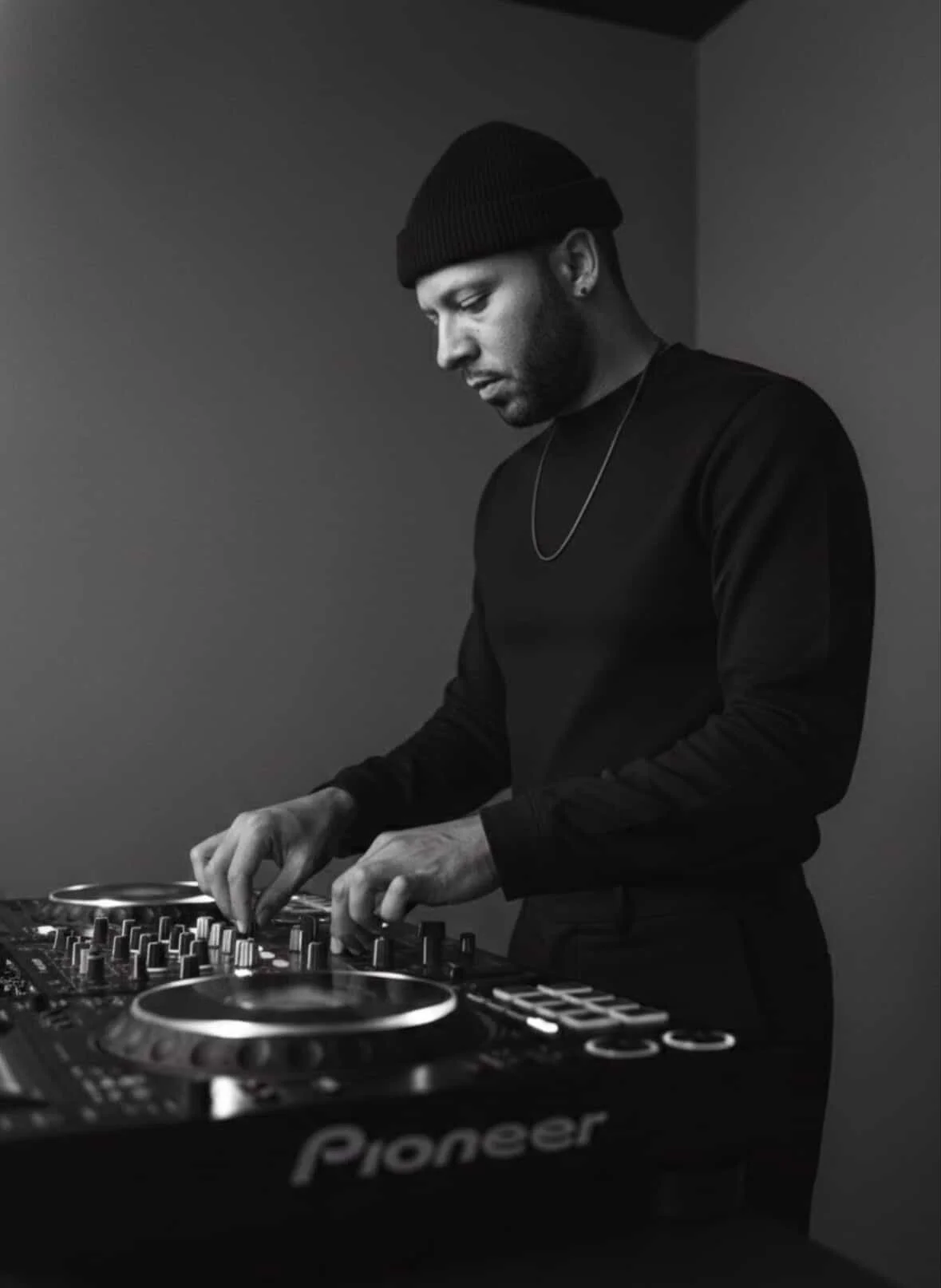
INTERVIEW TERRELL “REALIFE” BLACK PHOTOGRAPH @MARYVMOSES
In a world where music is constantly evolving, few artists manage to bridge the gap between its sacred origins and its technological future as seamlessly as Professor Moses. As a DJ, producer, and cultural architect, his work exists at the intersection of rhythm and ritual, innovation and intention. His sound—an immersive blend of Afro house, disco, techno, and soul—does more than move bodies; it awakens something deeper, connecting listeners to both ancestral frequencies and forward-thinking creativity.
For Professor Moses, music was never just background noise—it was a calling revealed early. A childhood moment at a Bobby Brown concert, standing in a spotlight as the crowd roared, became more than a fleeting memory. It was a profound introduction to the transformative power of performance and shared energy. That experience planted the seed for a lifelong pursuit rooted in expression, connection, and the unseen force that lives within sound.
That same awareness continues to shape his artistic philosophy today. In an era where artificial intelligence and digital tools are rapidly redefining music production, Professor Moses remains grounded in a simple truth: technology is only as powerful as the spirit guiding it. His approach balances cutting-edge innovation with a deep respect for the Black cultural lineage that gave birth to house music—ensuring that every track carries both intention and authenticity.
Based in Los Angeles, a global hub of cultural convergence, Professor Moses draws inspiration from a rich mosaic of influences. The city’s diversity fuels his ability to create music that transcends borders, blending rhythms and traditions into a unified sonic experience. Whether behind the decks or in the studio, he treats music as a universal language—one capable of bringing people together in ways that words often cannot.
But his creativity doesn’t stop at music. From his beginnings as a visual artist to his evolution into DJing and production, every facet of his work is connected by a singular purpose: to create meaningful experiences. Whether through his performances, his nonprofit World Famous House Crew, or his spiritually driven platform GodWave, Professor Moses is committed to building spaces where culture, faith, and creativity coexist and thrive.
In this conversation with Validated Magazine, Professor Moses opens up about his journey, his philosophy, and the vision behind his latest album, A Thin Line Between Light and Dark. More than just an artist, he reveals himself as a guide—someone using rhythm as a tool for liberation, healing, and unity. As the lines between music, technology, and spirituality continue to blur, Professor Moses stands at the forefront, reminding us that while the tools may change, the soul of the music must always remain.
VALIDATED: What is your earliest memory of music capturing your attention and truly drawing you in? Can you describe where you were, what you were hearing, and how it made you feel in that moment? At what point did you realize it was more than just a sound in the background and something that genuinely connected with you?
PROFESSOR MOSES: I remember being at a Bobby Brown concert when I was super young—maybe five or six years old. I was dancing in the aisle by the stairs on a platform when they put the spotlight on me and everyone started cheering.
It was a powerful moment for me because I could feel the power of music, performance, and the energy from the crowd. That moment was special because I was simply enjoying myself and expressing who I was, yet it ended up inspiring so many people.
VALIDATED: You blend Afro house, disco, techno, R&B, and AI-assisted production into a sound that feels both ancestral and futuristic. How did you arrive at that balance between tradition and technology?
PROFESSOR MOSES: For me, house music has always been about honoring the past while building the future.
House music was born from Black creativity—disco, soul, gospel, funk, and the rhythm of the diaspora. When I create music, I’m very conscious that I’m participating in a lineage that came from people expressing freedom through sound.
At the same time, we’re living in a technological era that gives artists incredible tools. AI, digital production, and new music technologies expand the palette of what we can create.
My approach is simple: technology is the instrument, but spirit is the composer.
I use AI and modern tools to explore textures, rhythms, and ideas faster, but the intention always comes from a human place—emotion, spirituality, and storytelling. If the music doesn’t feel alive, then the technology doesn’t matter.
The balance comes from respecting where the music came from while remaining curious about where it can go.
VALIDATED: As a Los Angeles–based DJ and producer, how has the city’s cultural diversity shaped your approach to house music and spiritual expression?
PROFESSOR MOSES: Los Angeles is a powerful cultural crossroads. You have influences from Africa, Latin America, Asia, and Europe—everything converges there.
That diversity shows up in the music.
In Los Angeles, you might hear Afro rhythms, Latin percussion, disco grooves, hip-hop energy, and techno futurism all in the same night. That environment naturally pushes you to think outside of one genre or one cultural lane.
For me, house music is already global music. Los Angeles just amplifies that.
Spiritually, the city also exposes you to many philosophies—faith traditions, meditation practices, and creative communities. All of that shapes how I see music as something sacred.
When I DJ in Los Angeles, I’m not just playing songs. I’m guiding an experience where all of these cultures can move together in one rhythm.
That’s powerful.
VALIDATED: You’re a multifaceted creative—an artist, DJ, and producer. Which came first for you, and how did one role naturally evolve into the others? If you had to choose just one lane to stay in, which would it be and why?
PROFESSOR MOSES: I’ve been a visual artist my whole life—from drawing all over my notebooks in school to covering the walls in my room while growing up. I’ve always been fascinated by art, graphic design, typography, iconography, and color.
DJing came next. I was 21 years old when I decided to invest thousands of dollars into becoming a DJ while I was in college. I used to watch my favorite rappers on Rap City: The Basement, and they always had a dope DJ setup. I remember saying to myself, “If it’s good enough for them, that’s what I want.”
Right around that time, the very first vinyl-to-MP3 system, Final Scratch, was introduced. I grabbed that system and practiced every day while I was in college. I basically decided to quit playing video games because I had been spending so much time on them. Instead, I redirected that time into DJing and producing. Reason 4 was my entry point into music production.
DJing is where I first learned how music affects people in real time. When you’re behind the decks, you’re studying energy. You learn how rhythm moves people and how a single record can shift the emotional direction of a room.
That curiosity naturally led me deeper into producing. I started asking myself questions like: What if I could create the records that move people the way I imagine?
Production became a way to translate my ideas into sound.
Art, visual storytelling, and cultural projects all come from the same place. They’re simply different expressions of the same creative impulse.
If I had to stay in one lane, it would probably be DJing and producing, because that’s where the exchange with the audience happens most directly. There’s something magical about seeing people experience music together in real time.
VALIDATED: You describe your music as “rhythm as ritual and music as movement.” What does that philosophy mean to you in practice—both in the studio and on stage?
PROFESSOR MOSES: When I say “rhythm is ritual,” I’m acknowledging something ancient.
For thousands of years, people have used rhythm in ceremonies, celebrations, and spiritual gatherings. Drums and repetitive patterns create a shared trance state where people feel connected to something bigger than themselves.
House music carries that same energy.
In the studio, I think about how rhythm creates movement in the body and emotion in the spirit. I’m a dancer when I go out and listen to music, so I approach DJing and producing from that perspective. I want the grooves to feel hypnotic, grounding, and uplifting at the same time.
On stage, that philosophy becomes very real.
A DJ set becomes a collective ritual. People are dancing, releasing stress, and celebrating life. For a few hours, everyone is present in the same vibration.
It’s a magical thing.
VALIDATED: How are you incorporating AI into your production process, and how do you ensure the human and spiritual elements remain at the center of your sound?
PROFESSOR MOSES: AI is a creative accelerator.
It allows me to explore ideas quickly—textures, harmonies, voices, and experimental sounds that might take longer to build from scratch.
But the key is intention.
The soul of a record still comes from human choices: the groove, the emotion of the chords, and the storytelling within the arrangement. I create all of my own lyrics and melodies before AI gets involved.
I see AI the same way musicians once saw synthesizers or drum machines—it’s a tool.
The human spirit still decides what feels true.
VALIDATED: In 2025, you released A Thin Line Between Light and Dark. What has the response to the project been like so far?
PROFESSOR MOSES: The response has been really meaningful.
The album explores contrast—light and shadow, wisdom and struggle, reflection, love, loss, and celebration. A lot of people have told me they feel that emotional depth when they listen to the project.
That’s important to me because I don’t want the music to be just functional for the dance floor. I want it to tell stories and create space for reflection.
Seeing listeners connect with that balance has been very rewarding.
VALIDATED: My favorite records from the album include “Smoky Room of Trust,” “Cold Winter,” “Don’t Let Them Play With You,” and “Thank You For The Wisdom.” Which tracks have resonated most with the fans?
PROFESSOR MOSES: Those are definitely some of the ones people mention often.
“Don’t Let Them Play With You” resonates because it carries a message about self-respect, confidence, and clarity. People feel that energy immediately.
“Smoky Room of Trust” has a more introspective vibe that a lot of listeners connect with, especially when dealing with a lack of trust and how that impacts our spirit.
“Thank You for the Wisdom” is a tribute to the people I’ve met and lost along the way. I’m grateful for everyone who has been a part of my life. Even though things don’t always work out the way we want them to, I’m still thankful for whatever time and experiences I’ve been able to share with people during this short life we have.
It’s beautiful to see how different songs speak to different people.
VALIDATED: As the founder of World Famous House Crew, what gaps did you see in the house music community that inspired you to create a nonprofit focused on uplifting Black voices?
PROFESSOR MOSES: House music was created by Black communities, but over time many of those voices became less visible in the industry. I used to go to shows all over LA, and venues would treat me like I was just a guest. Honestly, it would piss me off. So I decided I’d rather transmute that energy into something positive than just sit there being mad.
I wanted to help rebalance that. I started thinking about what I could create that would give more respect and balance to an industry I love—one that was founded by Black culture.
World Famous House Crew exists to celebrate and uplift the cultural roots of house music while creating opportunities for the next generation of artists. We go into schools here in LA and teach kids about house music.
We also expand our reach through events, digital content, education, and community programming.
The goal is to make sure the culture continues to thrive while honoring where it came from.
VALIDATED: How important is youth education to your overall mission?
PROFESSOR MOSES: It’s extremely important.
Music can change a young person’s life. It can give them confidence, community, and creative direction. There are so many opportunities to make a great living in the house music industry—from production and DJing to events, management, and content creation. It’s a huge industry, and I want to show young people that it’s theirs to be a part of, even if the demographics of the industry don’t always look like them.
When kids learn about house music and its history, they also learn about cultural pride, innovation, and resilience.
VALIDATED: GodWave merges faith, art, and high-level production into transformative experiences. What sparked the vision for that platform?
PROFESSOR MOSES: GodWave came from a simple idea: creativity, culture, and faith don’t have to be separate. We see that a lot of dark energy in the world gets a ton of resources behind it—whether in music, Hollywood, or social media. We are here to create a culture that celebrates people’s faith and connection to God.
Music, storytelling, and unique experiences can become spaces where people reconnect with purpose, joy, and faith.
GodWave is about creating experiences where people feel uplifted—emotionally, spiritually, and creatively. The goal is to build the coolest “church, synagogue, or mosque” in the world without needing an actual physical space. We want people to know that it’s cool to believe in God, and that faith is something no one should be afraid of.
VALIDATED: When people leave one of your sets or experiences, what do you hope they carry with them?
PROFESSOR MOSES: I hope they leave feeling lighter—happy to be alive and grateful for the chance to experience the joys life brings. My main goal is to inspire people to dance. That’s a big part of my name, Professor Moses—my intention is to liberate people to move their bodies without being self-conscious.
It’s wild how many people are afraid to let loose and just dance. Everyone has a body, so to me, dancing is one of the most basic forms of self-reflection. If people are hesitant to do that, they’ll likely be hesitant to express themselves in other ways too.
I want people to leave more connected to themselves, more connected to the people around them, and more hopeful about life.
If someone leaves inspired, joyful, or reflective, that’s a huge success.
VALIDATED: Looking ahead, what does long-term impact look like for you—not just as a DJ or producer, but as a cultural architect?
PROFESSOR MOSES: Long-term impact means building structures that outlive me—organizations, communities, art, music, platforms, and cultural movements that empower artists and bring people together.
Music can spark change, but culture sustains it.
My goal is to help build environments where creativity, spirituality, and community can thrive together.
VALIDATED: Where can readers tap in to support the album and stay connected with everything Professor Moses?
PROFESSOR MOSES: You can find my music on all major streaming platforms under Professor Moses.
You can also connect with me online and follow the work we’re doing through World Famous House Crew, GodWave, and the Future Visionary Collective.
Everything I create is ultimately about building community and celebrating the power of music and creativity. I’m here to help as many creatives as possible make a living through their art. I share content on my Future Visionary Collective page to support that mission.